How to Identify Rough Yellow Gemstones
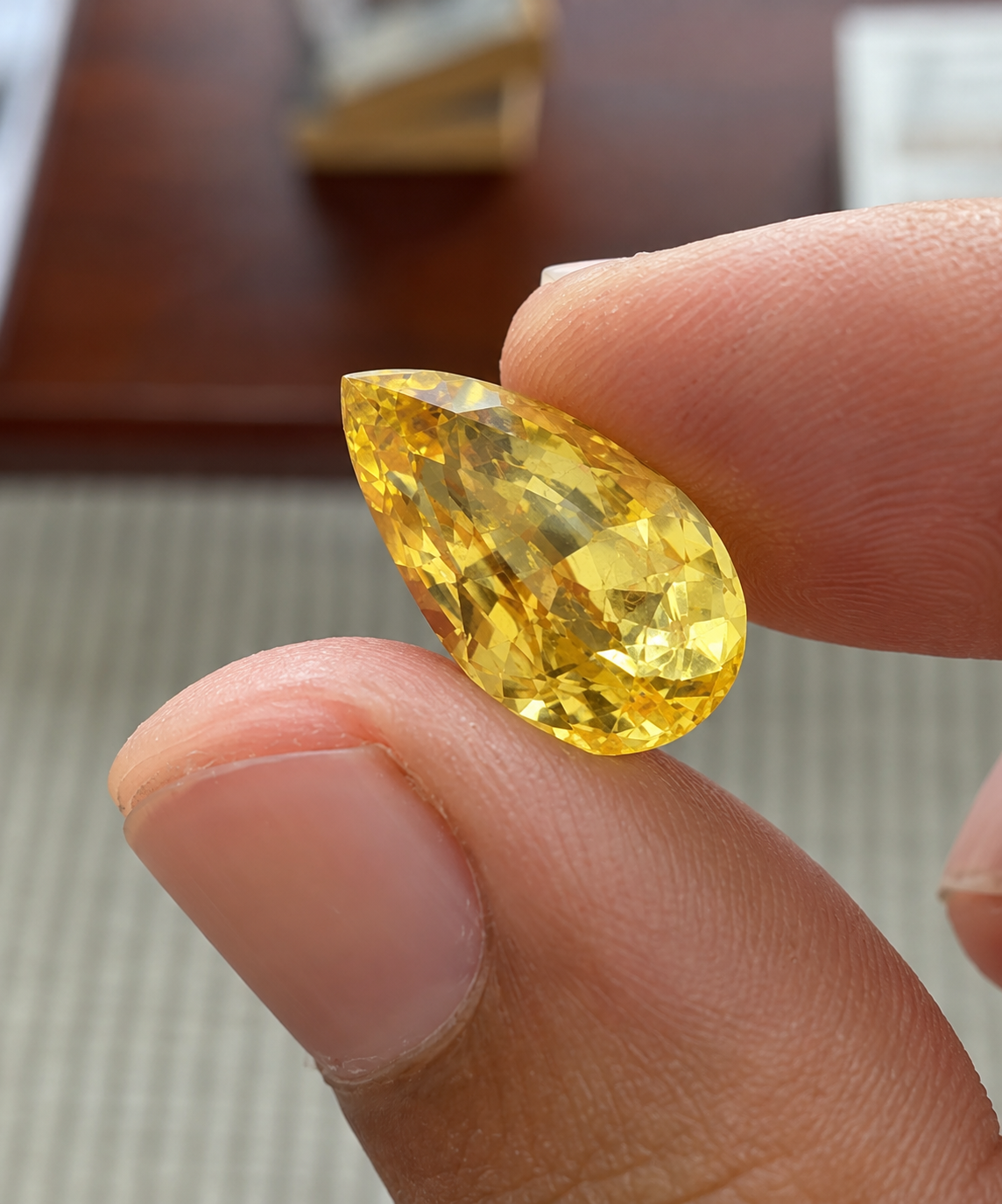
Ceylon Yellow Sapphire, also known as Sri Lankan Yellow Sapphire, is one of the most sought-after yellow gemstones from Sri Lanka. Its attractive yellow to golden colour, excellent durability and natural occurrence in Sri Lanka make it an important gemstone in the Ceylon sapphire market.
However, when buying rough Yellow Sapphire, especially in Sri Lanka gem market, it is important to distinguish genuine corundum from other yellow gemstones that may look similar.
Yellow Zircon, Jargon (Jargoon) and Citrine can all occur in yellow, golden or honey-like colours. To identify a natural Ceylon Yellow Sapphire reliably, colour alone is not enough.
A proper examination should consider crystal habit, optical properties, refractive index, specific gravity, hardness and inclusions together.
The most reliable gemstone identification comes from combining several properties rather than relying on a single test.
What Is Ceylon Yellow Sapphire?
Ceylon Yellow Sapphire is the yellow variety of corundum (Al₂O₃) originating from Sri Lanka.
Sri Lanka is internationally recognised for its sapphire deposits, particularly those associated with the gem-producing areas around Ratnapura and other parts of the country.
Ceylon Yellow Sapphire can occur in a wide range of yellow colours, including:
- Pale yellow
- Lemon yellow
- Golden yellow
- Honey yellow
- Vivid yellow
- Yellow-orange
The colour, clarity, size, treatment status and overall quality can have a major effect on the value of a natural Yellow Sapphire.
Key properties of Ceylon Yellow Sapphire
- Mineral: Corundum
- Crystal system: Trigonal
- Chemical composition: Al₂O₃
- Mohs hardness: 9
- Specific gravity: Approximately 4.00
- Refractive index: Approximately 1.762–1.770
- Optical character: Doubly refractive
- Birefringence: Approximately 0.008–0.010
The hardness of 9 makes sapphire one of the most durable natural gemstones for jewellery.
Ceylon Yellow Sapphire vs Yellow Zircon vs Citrine
At first glance, a yellow rough stone can be difficult to identify.
Here is a useful comparison:
| Property | Ceylon Yellow Sapphire | Yellow Zircon / Jargon | Citrine |
|---|---|---|---|
| Mineral | Corundum | Zircon | Quartz |
| Crystal system | Trigonal | Tetragonal | Trigonal |
| Optical character | DR | DR | DR |
| Mohs hardness | 9 | 6–7.5 | 7 |
| Specific gravity | ~4.00 | ~3.90–4.73 | ~2.66 |
| Refractive index | 1.762–1.770 | 1.810–1.984 | 1.544–1.553 |
| Typical colour | Yellow to golden yellow | Yellow, honey, golden, brownish yellow | Yellow to orange |
| Typical crystal habit | Corundum / hexagonal-related | Tetragonal prism | Hexagonal quartz prism |
| Birefringence | Low | Often high | Low |
These differences can be extremely useful when identifying a rough Ceylon Yellow Sapphire.
1. Identifying Ceylon Yellow Sapphire in Rough Form
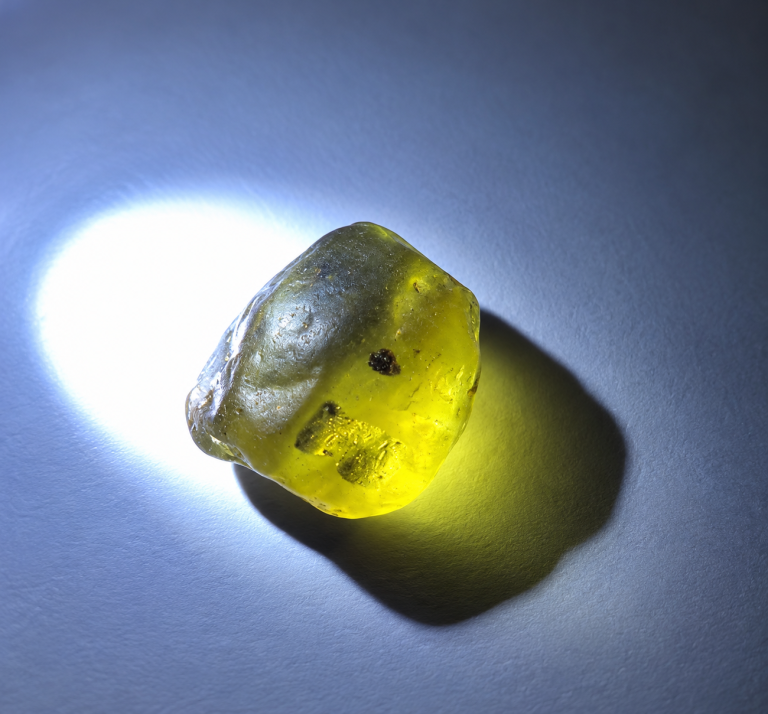
A rough Ceylon Yellow Sapphire may not look like a finished faceted gemstone.
Natural rough corundum can occur as:
- Barrel-shaped crystals
- Hexagonal-related crystal forms
- Rounded alluvial pieces
- Broken crystals
- Irregular fragments
A well-preserved rough crystal may show characteristic corundum crystal faces. However, many gemstones found in alluvial deposits have been naturally worn and may no longer retain their original crystal shape.
Therefore, crystal shape should be treated as an important clue, not proof of identification.
What to look for
When examining rough material, look for:
- Yellow or golden colour
- Good transparency or translucency
- Corundum-type crystal habit
- Natural zoning
- Internal inclusions
- Suitable SG
- Sapphire-range refractive index
For valuable rough material, these observations should be confirmed with proper gemological testing.
2. Yellow Zircon
Yellow Zircon is a completely different mineral from Yellow Sapphire.
Zircon is zirconium silicate (ZrSiO₄) and belongs to the tetragonal crystal system.
It can occur in:
- Yellow
- Golden yellow
- Honey
- Brownish yellow
- Orange
- Red
- Blue
- Green
- Colourless
Important properties of Yellow Zircon
- Crystal system: Tetragonal
- Mohs hardness: Approximately 6–7.5
- Specific gravity: Approximately 3.90–4.73
- Refractive index: Approximately 1.810–1.984
- Optical character: Doubly refractive
- Birefringence: Often strong
One of the most useful clues when comparing Zircon with Yellow Sapphire is its strong optical doubling.
Zircon can also have a significantly higher refractive index and dispersion than sapphire, contributing to its characteristic brilliance.
3. What Is Jargon or Jargoon (ජාගුන්)?
The term Jargon, Jargoon or similar trade names can sometimes cause confusion when buying gemstones in Sri Lanka.
Historically, Jargon/Jargoon has been associated with zircon, rather than representing a separate mineral species.
Therefore, if a rough yellow gemstone is offered as “Jargoon” or “Jargon”, it should not automatically be treated as a gemstone completely different from Zircon.
The actual mineral should be established through gemological testing.
Important distinction
Yellow Zircon and Jargon/Jargoon may refer to the same mineral species: zircon.
However, local terminology and commercial usage can vary, so it is important to confirm the material rather than relying solely on the trade name.
4. Citrine
Citrine is a yellow to orange variety of quartz.
Its lower density makes it particularly useful to distinguish from Yellow Sapphire and Zircon.
Important properties of Citrine
- Mineral: Quartz
- Crystal system: Trigonal
- Mohs hardness: 7
- Specific gravity: Approximately 2.66
- Refractive index: Approximately 1.544–1.553
- Optical character: Doubly refractive
Citrine may appear:
- Lemon yellow
- Pale yellow
- Golden yellow
- Honey
- Orange
- Brownish orange
Natural quartz crystals commonly form six-sided prismatic crystals with pointed terminations.
5. Why Specific Gravity Is Useful
One of the easiest ways to distinguish Citrine from a Ceylon Yellow Sapphire is specific gravity.
Approximate values are:
Citrine: ~2.66
Ceylon Yellow Sapphire: ~4.00
Zircon: ~3.90–4.73
This means Citrine is significantly less dense.
If two rough gemstones appear similar in size, the Citrine specimen will generally feel considerably lighter than a Yellow Sapphire or Zircon.
However, hand weight is only a preliminary indication.
For accurate identification, a proper hydrostatic specific gravity test should be used.
6. Using a Spinel Card or Polaris Card
A Spinel Card, sometimes referred to as a Polaris Card or Double Refraction Card, can be useful as a quick screening tool.
However, there is an important limitation.
Ceylon Yellow Sapphire, Zircon and Citrine are all DR
All three are doubly refractive (DR):
- Ceylon Yellow Sapphire → DR
- Yellow Zircon → DR
- Jargon/Jargoon → DR, if it is zircon
- Citrine → DR
Therefore, simply seeing DR does not identify the gemstone.
Instead, the degree of visible doubling can provide an additional clue.
Typical observation
Ceylon Yellow Sapphire
Double refraction is relatively weak and may be difficult to observe.
Citrine
Double refraction is also relatively weak.
Zircon
Double refraction can be considerably stronger and may be much easier to observe.
This is particularly useful when comparing a suspected Zircon with a Yellow Sapphire.
7. How to Use the Spinel Card on Rough Gemstones
When examining a transparent piece:
- Place the card in suitable lighting.
- Position the gemstone so that you can observe an internal or reflected line.
- Rotate the stone slowly.
- Look for a single or doubled image.
- If doubling is visible, observe the degree of separation.
- Repeat from different directions where possible.
However, rough gemstones can produce misleading results because of:
- Surface irregularities
- Internal fractures
- Cloudiness
- Inclusions
- Poor transparency
- Irregular crystal orientation
Therefore:
The Spinel Card should be used as a screening tool, not as the final identification method for a valuable Ceylon Yellow Sapphire.
8. Crystal Shape Can Help Identify Rough Gemstones
Crystal habit is especially useful when buying rough gemstones because a natural crystal may preserve clues about its mineral structure.
Ceylon Yellow Sapphire
Corundum belongs to the trigonal crystal system and can show hexagonal-related or barrel-shaped forms.
A natural rough sapphire may also appear rounded or irregular after weathering and transportation.
Yellow Zircon / Jargon
Zircon belongs to the tetragonal crystal system.
Look for:
- Prismatic crystals
- Four-sided crystal forms
- Pyramid-like terminations
- Distinct crystal faces
Citrine
Quartz is also trigonal and commonly forms:
- Six-sided prisms
- Pointed terminations
- Typical quartz crystal faces
Because both corundum and quartz can show six-sided crystal-related forms, crystal shape alone cannot reliably distinguish Ceylon Yellow Sapphire from Citrine.
9. Examining Rough Yellow Gemstones with a 10× Loupe
A 10× loupe is an essential basic tool when examining gemstones.
For a suspected Ceylon Yellow Sapphire, look for:
- Rutile silk
- Mineral crystals
- Colour zoning
- Healed fractures
- Fingerprint-like inclusions
- Growth structures
Not every natural sapphire will contain all of these features.
Yellow Zircon
Look for:
- Strong optical doubling
- Mineral inclusions
- Growth features
- Internal fractures
- High brilliance in transparent material
Citrine
Look for:
- Quartz growth features
- Fractures
- Fluid-related inclusions
- Colour zoning
10. Natural Citrine vs Heat-Treated Amethyst
There is another important consideration when buying yellow quartz.
A significant amount of commercial Citrine is produced by heat treatment of Amethyst.
Therefore, simply seeing yellow quartz does not prove that the colour is naturally occurring.
If a stone is being sold specifically as natural Citrine, further gemological examination may be necessary to establish its origin and treatment status.
This is especially important when purchasing higher-value natural gemstones.
11. How to Identify a Ceylon Yellow Sapphire: Practical Testing Sequence
If you are examining a suspected Ceylon Yellow Sapphire in Sri Lanka gem market, the following sequence can be useful.
Step 1 — Examine the colour
Look at the gemstone under natural daylight and neutral white light.
Consider whether the colour is:
- Lemon yellow
- Golden yellow
- Honey yellow
- Vivid yellow
- Yellow-orange
Colour alone is not enough for identification.
Step 2 — Examine transparency
Determine whether the rough stone is:
- Transparent
- Translucent
- Opaque
Transparent material allows more optical testing.
Step 3 — Examine the crystal habit
Look for evidence of:
- Corundum crystal structure
- Tetragonal zircon crystal structure
- Quartz crystal structure
Step 4 — Examine the stone under 10× magnification
Look for:
- Inclusions
- Growth features
- Colour zoning
- Fractures
- Internal characteristics
Step 5 — Perform the DR test
Use a Spinel/Polaris Card as a preliminary optical test.
Remember that all three gemstones can be DR.
Step 6 — Measure refractive index
A calibrated gemological refractometer provides significantly more useful information.
Approximate ranges:
- Ceylon Yellow Sapphire: 1.762–1.770
- Zircon: 1.810–1.984
- Citrine: 1.544–1.553
Step 7 — Measure specific gravity
Hydrostatic SG testing can provide another important confirmation:
- Sapphire → ~4.00
- Zircon → ~3.90–4.73
- Citrine → ~2.66
Step 8 — Obtain laboratory identification for valuable stones
When purchasing an expensive stone represented as a natural Ceylon Yellow Sapphire, professional gemological testing is the safest way to confirm its identity and, where relevant, treatment status.
12. Do Not Use a Scratch Test on Valuable Rough Sapphire
Although hardness is a useful diagnostic property, deliberately scratching a gemstone is not recommended when buying potentially valuable material.
Ceylon Yellow Sapphire has a Mohs hardness of approximately 9, while Zircon is approximately 6–7.5 and Citrine approximately 7.
A scratch test can cause unnecessary damage or reduce the value of a rough gemstone.
Use non-destructive gemological methods whenever possible.
Ceylon Yellow Sapphire vs Zircon vs Citrine: Quick Identification Guide
| Test | Ceylon Yellow Sapphire | Yellow Zircon / Jargon | Citrine |
|---|---|---|---|
| Mineral | Corundum | Zircon | Quartz |
| Crystal system | Trigonal | Tetragonal | Trigonal |
| DR/SR | DR | DR | DR |
| Mohs hardness | 9 | 6–7.5 | 7 |
| SG | ~4.00 | ~3.90–4.73 | ~2.66 |
| RI | 1.762–1.770 | 1.810–1.984 | 1.544–1.553 |
| Birefringence | Low | Often high | Low |
| Rough crystal habit | Hexagonal-related / barrel-like | Tetragonal prism | Hexagonal quartz prism |
| Main identification clue | RI + SG + corundum characteristics | Strong doubling + high RI/SG | Low SG + quartz characteristics |
Buying Natural Ceylon Yellow Sapphire
If you are looking to buy a natural Ceylon Yellow Sapphire, particularly a valuable untreated stone, visual appearance should only be the beginning of the evaluation.
A professional assessment should consider:
Colour + Transparency + Crystal Habit + Inclusions + Refractive Index + Specific Gravity + Treatment Status
No single test should be considered conclusive on its own.
This is especially important when buying rough gemstones because natural alluvial material can be worn, fractured or partially covered by other minerals.
For valuable Ceylon Yellow Sapphire, independent gemological confirmation is recommended before making a significant purchase.
Final Thoughts
Yellow Sapphire, Yellow Zircon, Jargon/Jargoon and Citrine can sometimes look remarkably similar in rough form.
The most important differences are found in their mineral composition, crystal system, refractive properties, specific gravity and hardness.
Remember these key points:
1. Ceylon Yellow Sapphire is corundum
It has a hardness of approximately 9, an SG of approximately 4.00, and a refractive index of approximately 1.762–1.770.
2. Yellow Zircon and Jargon/Jargoon are generally associated with zircon
Zircon is tetragonal, has a high refractive index and can show strong optical doubling.
3. Citrine is quartz
Its SG of approximately 2.66 makes it substantially lighter than Sapphire and Zircon.
4. DR alone cannot identify the stone
Ceylon Yellow Sapphire, Zircon and Citrine are all doubly refractive.
5. Combine several tests
The safest approach is to combine:
Crystal habit → Loupe examination → DR test → Refractive index → Specific gravity → Laboratory confirmation
When the gemstone is valuable, proper gemological testing is always preferable to relying on appearance or a single field test.
For collectors and buyers seeking authentic Ceylon Yellow Sapphire, understanding these differences can help make a more informed gemstone purchase.